





When the deadline
is fixed, the model
has to be right.
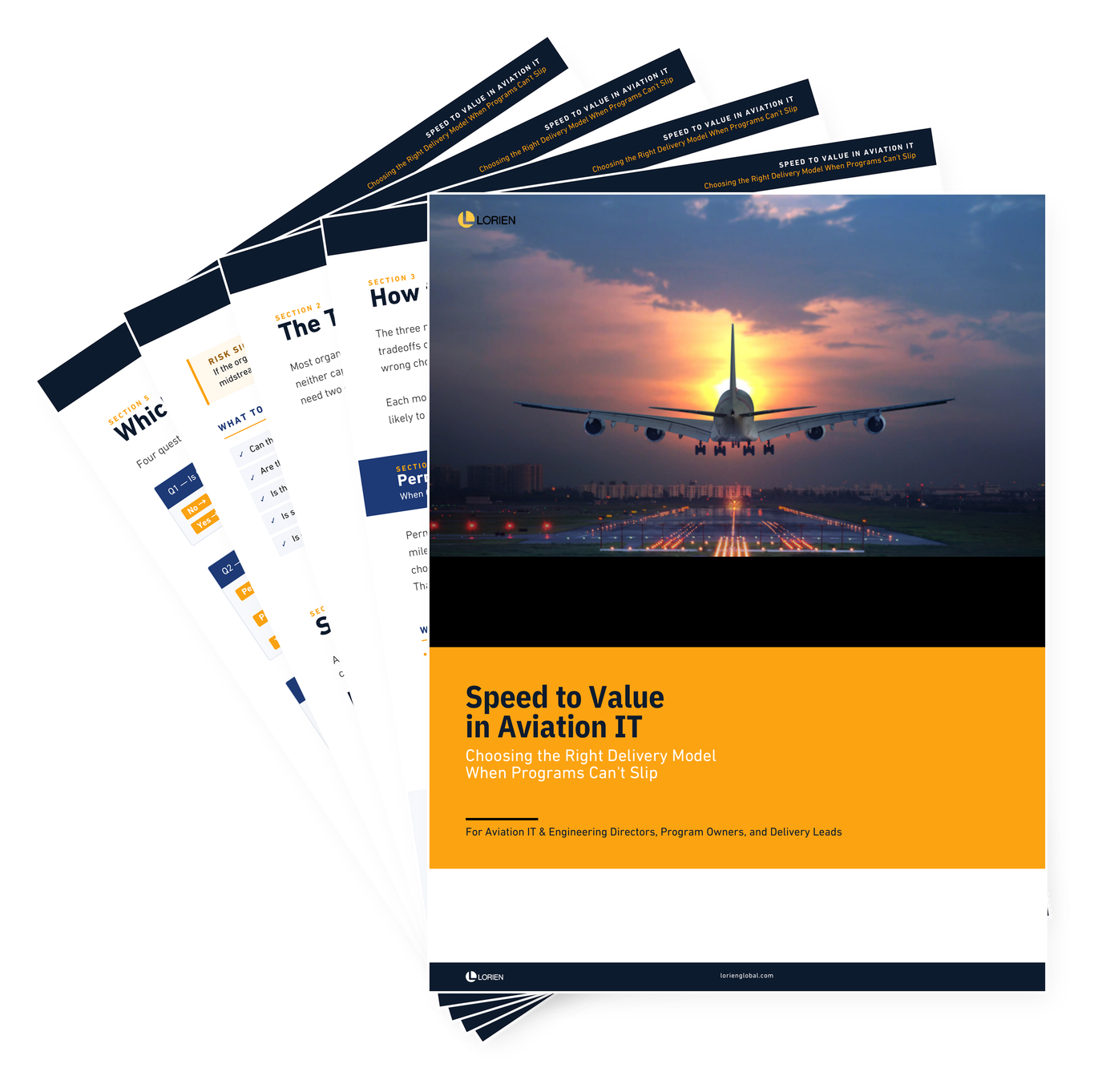
Aviation IT programs run against deadlines that don't move. This guide helps IT directors, program owners, and delivery leads choose the right model before the pressure arrives.
evaluated · free download
Download the guide
Fill in your details and receive it immediately.
Eight sections. One governing promise.
Every section is built around one question: does your current delivery model protect the timeline you've already committed to?
The Delivery Reality
Why aviation IT programs (cloud migrations, API modernisation, mobile crew apps) face delivery stakes that other industries don't.
The Two Clocks That Define Speed to Value
Time to fill and time to productive value measure different things. Most programs lose time on the second one.
How to Choose the Right Model
Permanent hiring, staff augmentation, and outcome-based delivery, each evaluated on both clocks with velocity risks made visible.
Hybrid Reality: Combining Models
Complex programs rarely run a single model. Learn to sequence models across phases without losing control at the handoffs.
Which Model Fits Your Moment
A four-question decision tree built from your constraints right now, not from what's worked before or what feels familiar.
Readiness, Checklists & Next Steps
Model-specific readiness checklists and a full Day One readiness pack, structured for planning conversations before commitments lock in.
Each model is right in specific circumstances.
The guide makes the tradeoffs visible early, before the wrong choice shows up as a delivery problem.
Permanent Hiring
When ownership and continuity matter mostBuilt for long-lived roles where institutional knowledge and organisational embedding are essential.
Best forStaff Augmentation
When targeted speed and flexibility matterA precision instrument. Adds the right capability at the right moment without changing internal governance or direction. Fast to add, but readiness determines whether it's fast to impact.
Best forOutcome-Based Delivery
When capacity without internal lift is the priorityThe team owns the scope and is accountable for milestones, not for filling seats. When set up properly, often the fastest path to output, but scope clarity is non-negotiable.
Best forCommon questions about aviation IT delivery models
What is the fastest delivery model for aviation IT programs with fixed deadlines?
There is no universally fastest model. The right answer depends on two factors: time to fill and time to productive value. Staff augmentation moves time-to-fill fastest when procurement is clear. Outcome-based delivery closes time-to-productive-value fastest when scope and dependencies are documented before the engagement starts.
When should I use staff augmentation versus outcome-based delivery?
Use staff augmentation when the work needs close integration with your internal team and you need elastic capacity. Use outcome-based delivery when the work can be clearly bounded with defined acceptance criteria and your team needs capacity without absorbing coordination overhead.
How long does it take to hire a specialist aviation IT contractor?
When supplier pipelines are active and procurement is clear, specialist aviation IT contractors can typically be sourced and confirmed in two to four weeks. Vendor onboarding, VMS workflow, and rate approvals can add equivalent time back invisibly if not mapped in advance.
What causes aviation IT programs to slip when using staff augmentation?
The most common causes are failures of readiness rather than failures of the model: no named onboarding owner, undefined week-one outputs, undocumented dependencies, and procurement steps not mapped before the search began.
Can I run multiple delivery models on the same aviation IT program?
Yes, and complex programs often require it. Common hybrid patterns include outcome-based delivery for a bounded Phase 1 milestone transitioning to staff augmentation for ongoing support, or augmentation holding velocity during a critical window while a permanent hire completes the full recruiting cycle.
The right model, chosen before the pressure arrives.
Download the complete decision framework, free from Lorien's Aviation IT practice.
Get the guide now →